Welcome to THE MATTA ARCHIVES
For historical information regarding works by the artist: info@robertomatta.com
For information regarding Certificates and Archives: info@mattaarchives.com
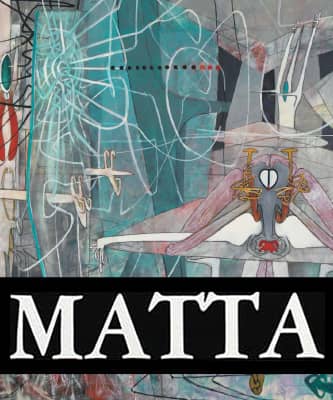
The Matta Archive is actively working on the production of Notebooks no. 2, no. 3, no. 4 and no. 5 to complete Germana Ferrari Matta's project of offering a complete account of Matta's work through the series of volumes dedicated to him.
Anyone who owns a work by Matta and wishes it to be included in the next volumes is requested to send a high-resolution photo of the front and back of the work specifying dimensions and information on provenance to:
Anyone interested in reserving a copy of the next volume now can write to us at:
ROBERTO MATTA
1911 - 2002
“I think that the role of the painter is to search not for the other reality but for the real reality. It is with the mental eye, creating a poetic gesture, how the truth can be reconstructed”
ROBERTO MATTA1
Matta is one of the most visionary painters of the 20th century whose contribution to art history is fully established, yet within his oeuvre are still discoveries to be made. His work is as relevant today as when the influential MoMA curator and Director of the Painting and Sculpture Department, William Rubin, wrote in 1985: “I have, myself, never stopped looking at Matta's work. For me, he was and remains one of the relatively few truly inventive and independent painters of the 20th century - indeed, one of a small number whose art has changed my life.”
“The person who turned us all on was Matta. He invented us all - it wasn't Mondrian or Léger or even Breton all of whom with many others were also refugees in New York, but Matta...”
ROBERT MOTHERWELL2
Matta's influence is felt throughout the 20th Century from groups of artists as diverse as Gorky, Motherwell, or Pollock - whose “grid paintings are also unthinkable without Matta [...],” as scholar Sir Norman Rosenthal puts it.
“Still a young man, Matta is the most profound painter of his generation.”
MARCEL DUCHAMP, 19443
Matta himself made no secret of his admiration for Marcel Duchamp. As the most noted historian of Surrealism, Prof. Dawn Adès, pointed out “it was Duchamp's paintings, and The Large Glass (La Mariée mise à nu par ses célibataires, même), that had a profound effect on him.”4
At the beginning of his career, Matta started out as an architect and worked with Le Corbusier himself. Having met Picasso while he was working on Guernica (exhibited at the Spanish Pavilion of the Paris International World's Fair in 1937, where Le Corbusier designed the Pavilion of New Times), Matta's future lay with painting. Robert Melville wrote in his preface to Matta's 1951 ICA exhibition in London “Painting always has one foot in architecture, one foot in dream.”
After originally working as an architect, not only with Le Corbusier, but also with Alvar Aalto and Walter Gropius during his youth in Europe, Matta brought a new concept of space to Surrealist painting, blending it with Abstract Expressionism and blowing the conceptual and constructive principles of modern architecture apart, opening it up to cosmic explosions and subjective implosions. He eventually integrated into his masterpieces socio- political commentaries, combined with his unique irony. Often crafting puns when titling his works, Matta utilized rich, sometimes almost bold colors to embed organic floating forms into his spatial architectures often in grand-scale canvases.
“What makes Matta's art so rich is that, from his earliest works, he was in possession of an entirely new color line, perhaps the only one, at least the most fascinating ever since Matisse. This range, whose gradation is based on a certain rose, already transforming, already famous, that Matta seems to have discovered (“the surprise, I have heard, will explode like a ruby fluorite into ultra- violet light”) is organized according to a complex prism.”
ANDRÉ BRETON, 19445
Matta, an early mentor to the Abstract Expressionist and Surrealist movements, was celebrated as a pioneering figure by Marcel Duchamp in 1946; “his first and important contribution to Surrealist painting was the discovery of regions of space hitherto unexplored in the realm of art.”6
“But Matta, whether in Paris or New York, where his ebullience and his vision dazzled our own young artists, merging in his big canvases the architecture of outer space with the conceits of earthly technologies, is indelibly here [...] Matta, worth a hundred pages of fantasies to match his own imagination.”
DOROTHEA TANNING7
This cosmopolitan and charismatic figure, who cultivated intellectual friendships with some of the key figures of 20th Century Art and Culture, deeply influenced the artistic development of his contemporaries. Robert Motherwell described Matta in 1967 as “the most energetic, enthusiastic, poetic, charming, brilliant young artist that I ever met,”8 and later in 1988 “Matta was indeed an electrifying personality [...] He carried an optimism, a sense of infinite possibilities of everything still to be done, that was a breath of fresh air in the bleakness of Greenwich Village.”9
During his mature years spent in Europe, he maintained friendships with Latin American intellectuals; Nobel Prize winner Octavio Paz wrote about Matta in 1985 “For forty years he has not stopped painting, thinking, loving, fighting, irritating, discussing, moving, outraging, enlightening. Juggler, engineer, illusionist, confused, inspired, stammering, talkative, magician, conjurer, clown, clairvoyant, poet, rebellious, generous. The sun always accompanies him. Nothing, there, surprises us; one of his mottos says: the sun to those who know how to gather. But another sun exists, a secret one, in front of which he knows how to remain alone and say no. Matta is illuminated, alternately, by two suns, that of the great place and that of the cell. Surrealism was a great, warm-hearted rebellion on this cruel and icy century. Matta remains faithful to this subversive and generous impulse. Matta is one of our great contemporary artists. He has been since its inception and it remains so.”10
Matta's work can be found in some of the most important private and public collections worldwide, such as the Centre Pompidou in Paris, the Stedelijk Museum in Amsterdam, the Museo Nacional Centro de Arte Reina Sofía in Madrid, the Art Institute of Chicago, the Guggenheim Museum and the Metropolitan Museum in New York, the MoMA, the LACMA in Los Angeles, the MALBA in Buenos Aires, Tate Britain in London, to name a few.
