He graduated in April 1935. His thesis Project for the League of Religions causes a scandal. It is a set of buildings with pure lines whose interiors, by contrast, are all curves and bends, in homage to the female body. He embarks with Manuel Marchant Lyon to Europe on the “El Arica”, a merchant ship. The crossing takes six months, with stops in Peru, Panama, Fort de France and Liverpool.
From the autoelastobiography:
Doctorate in Architecture at the Catholic University of Chile, with the project “The League of Religions” in Elefantina Island. I break the Gordian knot of Jesuits, family and Chile. Several months in the merchant navy on the “Transat. Round trip Liverpool/Fort-de-France.” Wandering around Europe. I walked around, spent time in museums taking notes. I had no contact with anyone. Maybe I was an architect but I realized I didn't know anything. At the age of twenty-one, I was starting again to learning everything. I spent a summer in Italy drawing the paintings that interested me. I was always alone without knowing why.
“It was this exile that determined my whole life, between two cultures. My work is a work of separation. From exile, I moved to the 'Ex-il' somewhere between the known and the unknown, between the reality and the imaginary where poetry begins.”
In October 1935 Matta is hosted in Paris by his aunt Olga Echaurren Herboso. He enters the studio of Le Corbusier. He spends the end-of-year vacations with his family at the Chilean embassy in Madrid. He meets poets Rafael Alberti and Federico Garcia Lorca, who give him a book of poems and a recommendation for Salvador Dali.
From the autoelastobiography:
1934 to 1936 Paris, Le Corbusier. The agency was unheated, rented from a convent on the Rue de Sèvres, a hallway with a few chairs. Le Corbusier always arrived at five o'clock and observed, his cousin Jeanneret was with us. We were actually working on his book, making drawings. There was no money, no construction sites. We were studying among ourselves. Sometimes he would look at the drawings that we were finishing for the Radiant City. He did not teach, and when at practice, there was none. In the fall of 1I started working with Le Corbusier. I was dividing my time between the Louvre and the Technical Library of Construction. In 1935 I met Federico Garcia Lorca, who gave me a copy of Llanto por Ignacio Sánchez Mejías with two words of recommendation for Dali who, having seen my drawings, sends me to two friends of his, Marchel Duchamp and André Breton, who have a gallery, La Gradiva.
He stayed in Portugal, met the poet Gabriela Mistral who helped him get to London. He works with Gropius and Moholy-Nagy. He meets Henry Moore, Roland Penrose, René Magritte, but the decisive encounter with the work of Marcel Duchamp occurs through Cahiers d'Art 1-2. In homage to Lorca, filmed in August '36 at the height of the Spanish Civil War, he wrote a draft of script of 162 scenes in Stockholm on the night of 31 December.
From the autoelastobiography:
Trip to Berlin for the Olympics (political recklessness). As a volunteer courier for the Le Corbusier I take to Moscow, to the Centrosoyuz, at their request, the new plants that will allow to transform the original air-conditioning project and thus open the windows! On the way back I pass through Leningrad, Helsinki, where I meet Alvar Aalto, Stockholm, Copenhagen, Brussels, Paris and arrive in Barcelona on 19 July 1936. SUMMER Lisbon. I am adopted by Gabriela Mistral, who initiates me into the poetry of José Martí and the Vasconcélos programme of the 'Cultural Brigades' in Mexico. AUTUMN In London with Gropius, Moholy-Nagy, Magritte, Henry Moore and Roland Penrose. 31 December 1936. In Stockholm, I sketch the scenario 'La Terre est un Homme'.
In January Matta travels to Addis Ababa, Ethiopia. Upon his return to Paris, he observes the genesis of Guernica while working for the Spanish pavilion at the Universal Exhibition in Paris. He becomes friends with Alberto Martinez, a communist baker who is also a sculptor, and with Gordon Onslow Ford, then a young naval officer. In the fall, Dali advises him to visit André Breton, who had just opened the Gradiva Gallery. Breton buys two drawings from him, declares him a Surrealist and invites him to meetings of the group. Patrick Waldberg still remembers Matta arriving at the gallery “full of drawings, at least a thirty or so, very talkative, and Breton, who although he understood nothing of what Matta was telling him, found the drawings beautiful and indeed immediately buys him two.” Leonardo da Vinci's theories about the stain and the construction of a hallucination take on for him their full significance. “His wandering ends when he joins the Surrealist group and marks his true birth symbolically as an artist and as a conscious being.” (mémoire Marine Nedelec)
From the autoelastobiography:
Paris, Universal Exposition. I was in a group collaborating on the construction of the pavilion Spain, the construction was delayed. There was civil war in Spain, the architect was not good, everything was sad. Meeting with Picasso working on “Guernica.” AUTUMN Meeting with André Breton.
In January presents 4 drawings at the Exposition Internationale du Surréalisme at the Galerie des Beaux-Arts. The last page of the Dictionnaire abrégé du Surréalisme reproduces another. Breton encourages him to write about architecture, and a text adapted by Georges Hugnet is published in the Minotaure magazine, “Mathématique sensible, Architecture du temps”, in response to Mathématique raisonnable by Le Corbusier. During his summer in Brittany at Trévignon, Gordon Onslow Ford encourages him to paint. He perfected his “automatic” technique, based on the reinterpretation of rubbings. He will create different morphologies (morphology of desire, of anguish, of encounter...) that he will also call Inscape. Illustrates one of Maldoror's songs and André Breton's poem, Cours les toutes. Frequent visitor to Marcel Duchamp, of whom he will become a collector. Marries American Ann Clark in Paris.
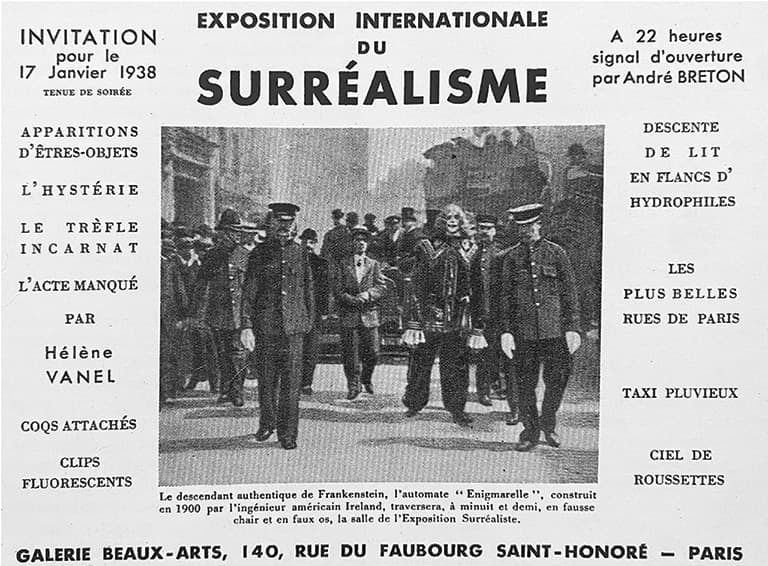
Invitation to the International Surrealism Exhibition. Paris, January 1938
From the autoelastobiography:
At the Deux Magots, with the Surrealists. I was like Jesus in the temple with the doctors of the law, a child. They gave me a creed, affection and an initiation into the verb to be. SUMMER Tréviglon. Encouraged by Gordon Onslow Ford, I paint my first canvases Inscape, Psychological Morphologies of despair, anguish, desire. After the summer I saw Picasso again, “You are painter, you are Saint Anthony, now you must work miracles.”
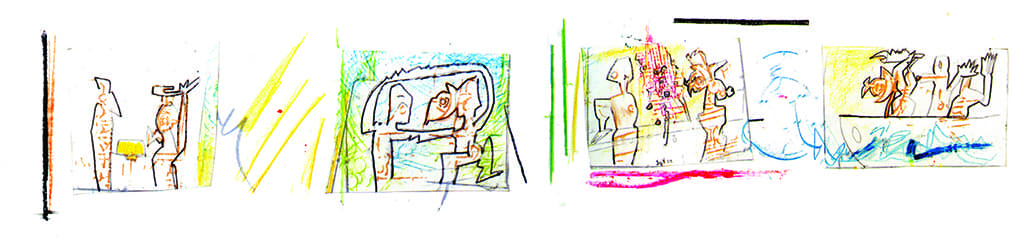
Breton writes in the journal “Minotaure” the text Des tendences des plus récentes du surrealisme, in which which presents Matta as one of Surrealism's most promising new recruits:
“One of our youngest friends, Matta Echaurren, has as of today in his hands the reins of a production extraordinary painting. In him there is no longer anything rational nothing that does not result from the will to deepen the faculty of divination through color, a faculty that belongs to him in an exceptional. The paintings painted by Matta from one year on are a feast in which every occasion is at play, a pearl that grows in an avalanche attracting to itself every physical and mental glow.”
Matta spends the summer of that year at the Chemillieu chateau rented by Gertrude Stein, André Breton, Gordon Onslow-Ford, Marcel Tean, Estéban Francés Tanguy and his wife Kay Sage. Returning to Paris, he lived for some time in La Roche-Guyon together with Pablo Neruda. Then on the advice of Marcel Duchamp, he embarks for New York on the same ship as Tanguy. In that city the two artists will both settle in the 'Village' not far from each other. Matta, one of the few Surrealists who speaks English, quickly conquers the artistic milieu New York, and in particular the art dealer Julien Levy, at whose gallery he will hold his first exhibition, between April and May '40. Writes Julien Levy:
“He was overflowing with premature optimism and impatient disappointment; he fervently believed in everything and believed in absolutely nothing; just as he did not believe in himself, ardently and painfully, all nothing at the same time. In my opinion, he was by far the most fertile of the young Surrealists, and at the same time the one who could be counted on the least.”
In addition to this exhibition, Matta participated in February in the International Exhibition of Surrealism, organized by W. Paalen, A. Breton and C. Moro at the Galeria de Arte Mexicano. In New York participates in the New School of Social Research directed by Meyer Shapiro. Gives lectures on the theory of Psychological Morphologies.
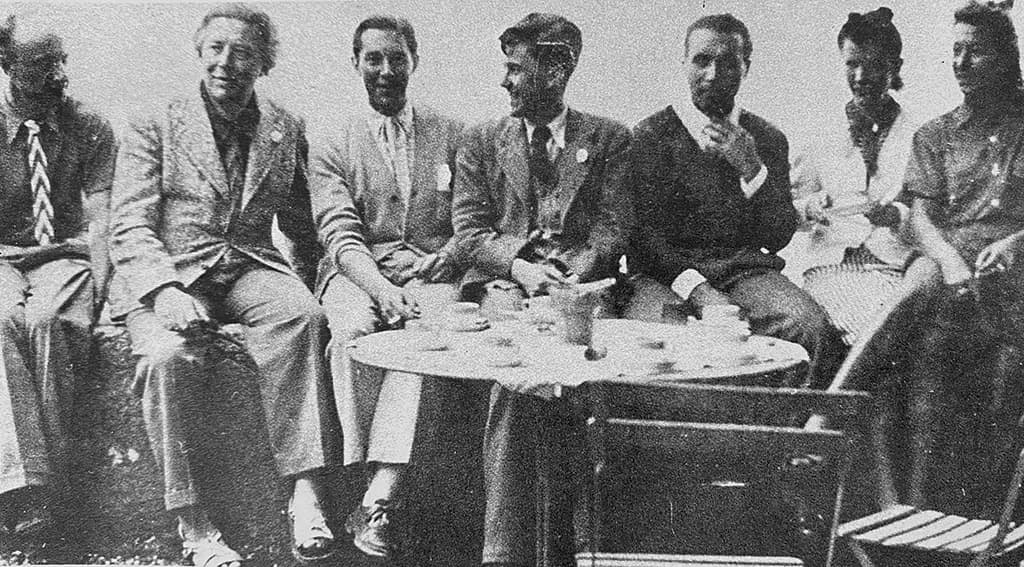
Tanguy, Breton, Onslow-Ford, Matta, Francés, Ann Matta Clark, Jacqueline Breton at the country house of Gertrude Stein, Biligny, Summer 1939
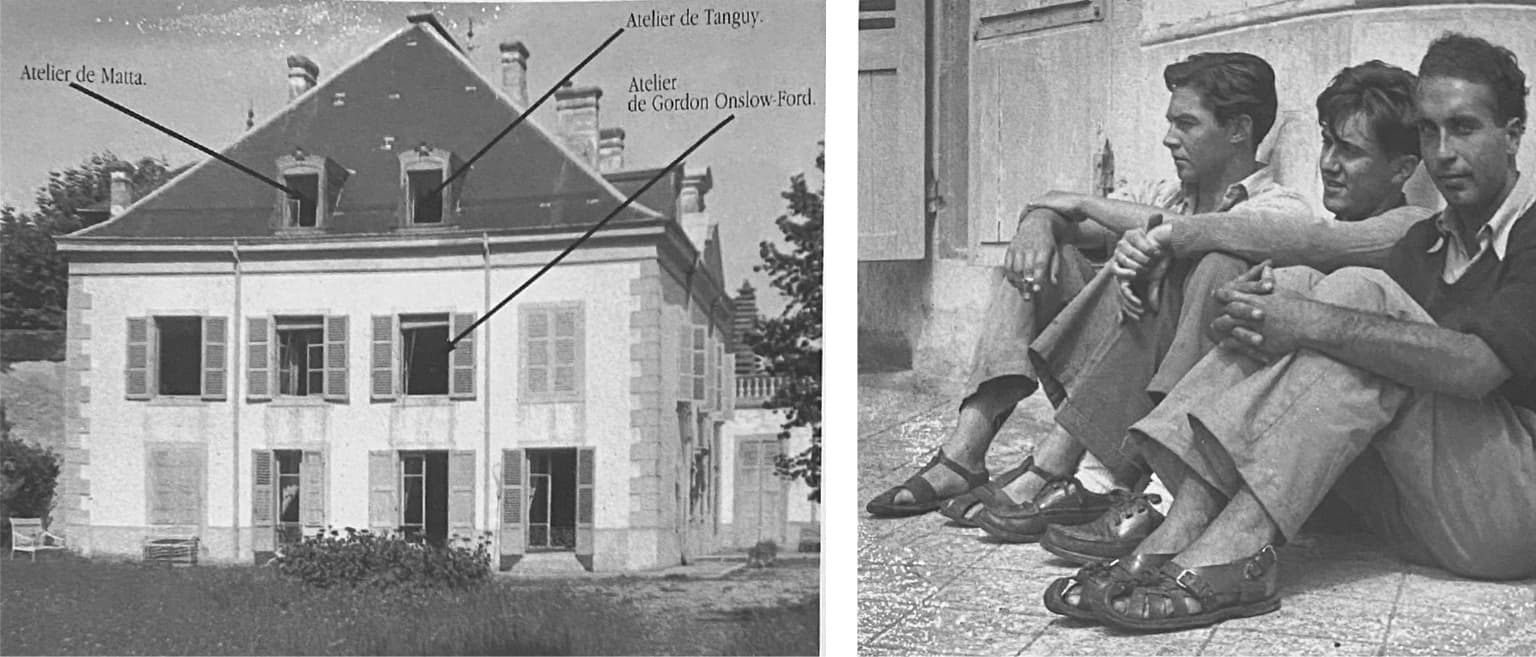
From the left: 1. Château de Chemillieu, Summer 1939, 2. Gordon Onslow-Ford, Matta, Estéban Francès, Chemillieu

From the left: 1. Matta, André Breton, Aube Bréton, Gordon Onslow-Ford, Estéban Francès, 2. Matta at Hauterives at the facteur Cheval's, 1939
From the autoelastobiography:
1939 SUMMER Chemillieu (Ain), with André Breton, Onslow Ford, Tanguy, Marcel Jean and many other guests, including Gertrude Stein, who had chosen the place for us.
SEPTEMBER Paris. Dialogues with Marcel Duchamp on the Passage de la Vierge à la Mariée.
OCTOBER Living with Pablo Neruda in La Roche -Guyon until his departure for New York.
NOVEMBER Arrival in New York. I meet up with Lége, Kurt Seligmann, Mondrian, Moholy-Nagy and Gropius, who wanted to organize the New Bauhaus in Chicago, and with whom I was to work thanks to a recommendation from Le Corbusier. Greenwich Village, Gay Street, Key Sage, Buñuel, Paalen, John Goodwin, David and Suzie Hare. Deux Magots coffee table again.
1940 New York. At the New School of Social Research, I meet Meyer Shapiro, Francis Lee and company: Edison Price and many artists: Pollock, Baziotes, Kamrowski, Gorky, Motherwell, F. Kiesler, critic Lionel Abel. Gordon Onslow Ford gives lectures: the works are discussed as psychic barometers recording the desires and drives of the community. APRIL First exhibition by Julian Levy of the canvases A la lumière noir, in the company of Tchelitchew and Walt Disney.

In January 1941, he got together with Gordon Onslow-Ford, who organized at the New School of Social Research directed by Meyer Shapiro, a lecture series entitled “Surrealist Painting, an Adventure into Human Consciousness”. The meetings are attended by many artists, including Baziotes, David Hare, Gorky and Motherwell. Over the course of the summer, Matta leaves with the latter for a trip to Mexico. Here, Motherwell “does in three months apprenticeship of ten years of surrealism”, while Matta becomes awareness of the “terrifying power of the earth”, which will inspire him a whole series of works such as Here sir Fire, Eat!, Invasion of the Night, The Disaster of Mysticism, and The Earth is a Man, and which will give the beginning of a particularly fruitful period. In that same year, he participated in several exhibitions, including two group shows on French painting by Pierre Matisse and an exhibition with Wilfredo Lam, at the Art Institute of Chicago. “The world of psychological morphology gives shape to our wildest thoughts. It is a paradise hell where everything is possible. Desire buried deep within us can be magically realized there.” Gordon Onslow Ford, “Psychological Morphologies,” London Bulletin, June 1940. In January, he meets again with Gordon Onslow Ford. From June to November, Matta and Ann Clark go to Mexico with Motherwell. Participates in two exhibitions of French painting at Pierre Matisse's and one with Wifredo Lam at the Art Institute in Chicago.
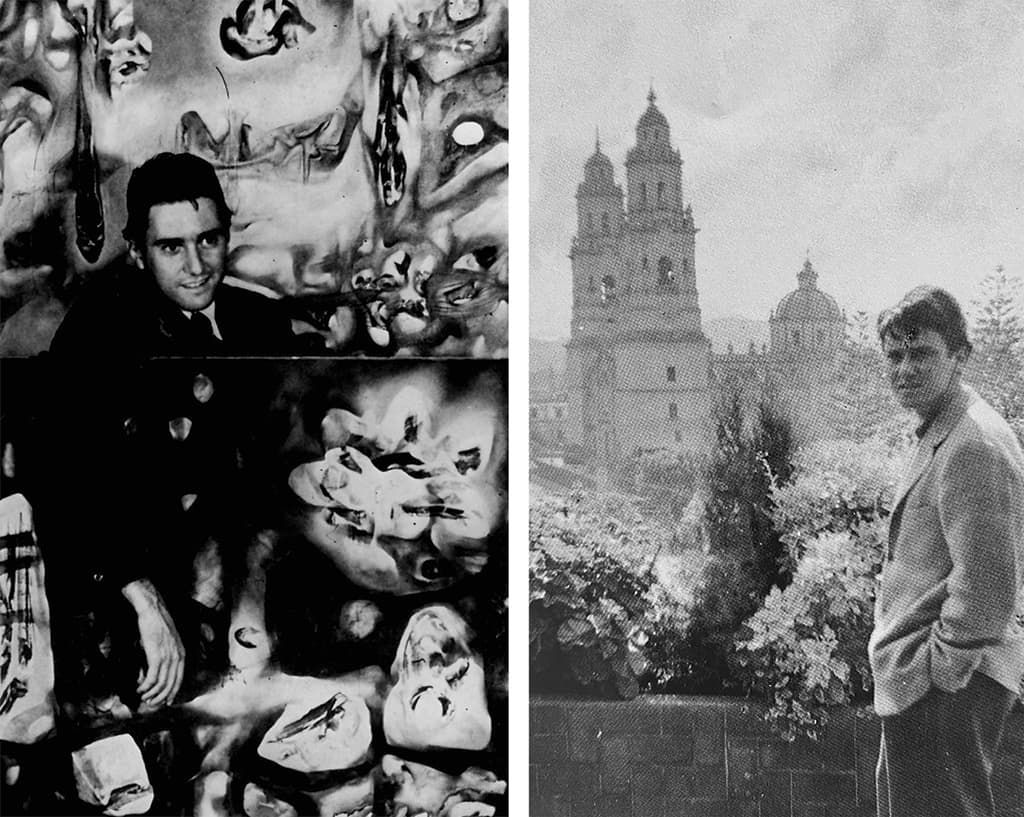
From the left: 1. Matta, New York, december 1941. Photo by Sidney Janis, 2. Matta, Taxco, 1941
From the autoelastobiography:
Leaves in spring for Mexico with Bob Motherwell, Barbara Reis, Ann Clark and Maria Ferreo in search of nature and the discovery of America. Work on canvases inspired by the power terrifying power of the continent: Ecouter vivre, Initiation.
Erongaricuaro, I witness the birth of the volcano “Paricutin.”

Loves a young woman he calls Nausicaa who dies in 1943. He exchanges drawings for records by Erik Satie. Reads Le Mystère de Dieu est accompli (The Mystery of God is Accomplished or Grammar Logic) by Jean-Paul Brisset. Participates in the Artists in Exile exhibition at the Pierre Matisse Gallery and in April opens his first solo exhibition. Critics are enthusiastic and the painting The Earth is a Man is sold to the Cliffords.
Illustrates “Les Prolégomènes à un troisième manifeste du surréalisme, ou non” written by André Breton for the first issue of the magazine VVV. Les Grands Transparents, the title of the drawing, shows the birth of one of the main themes of his work. First project for Matta. Text by André Breton relating to the theory of the Grands Transparents. The exhibition introducing Surrealism in New York, First Papers of Surrealism, opens in October. The set design was created by André Breton and Marcel Duchamp. The entire space is traversed by meters of white rope. The installation, heavily influenced by W.T. Soby, has a great impact on Matta. Following this exhibition, Matta, together with Motherwell, begins to become a spokesman for the Surrealist theories among young painters resistant to the prevailing social realism. Every Saturday, Baziotes, Busa, Kamrovsky, Pollock and Gorky would meet at his home. After a few months, tired of this propagandistic role, Matta produced a series of highly erotic etchings, entitled ironically The New School.
In October, Peggy Guggenheim opened her gallery Art of this Century.

From the left: 1.Robert Motherwell, Max Ernst, Peggy Guggenheim, Ann Matta Clark, Matta, Pegeen Veil and Maria Motherwell the unseen photographer. Provencetown, Massachusetts at Motherwell's house, 1942, 2. Photograph taken on the occasion of an exhibition at Pierre Matisse Gallery, March 1942. Left to right, first row: Matta, Ossip Zadkine, Yves Tanguy, Max Ernst, Marc Chagall, Fernand Léger; second row: André Breton, Piet Mondrian, André Masson, Amédée Ozenfant, Jacques Lipchitz, Pavel Tchelitchew, Kurt Seligmann, Eugene Berman. Photograph by George Platt Lynes.
From the autoelastobiography:
First exhibition at Pierre Matisse Gallery; La Terre est un Homme. Weekly lunches with Duchamp. Development of the idea of Large Transparencies leads to the painting Led Vitreurs. This incites Breton to ask me to illustrate Prolegomena to a Third Manifesto of Surrealism or not. Autumn in Wellfleet with Max Ernst, Ninth Street, New York, debates on automatism with Baziotes, Pollock and Gorky.
In March he exhibits at Julien Levy's and illustrates for the VVV almanac the poet Charles Duits' text “Le Jour est un attentat” (The day is an attack). Acquires from Julian Levy Giacometti's The Invisible Object. Paints his first large triptychs Prince of Blood, Redness of Lead, La Vertu noire and a canvas in homage to Duchamp, The Bachelors, Twenty Years After.
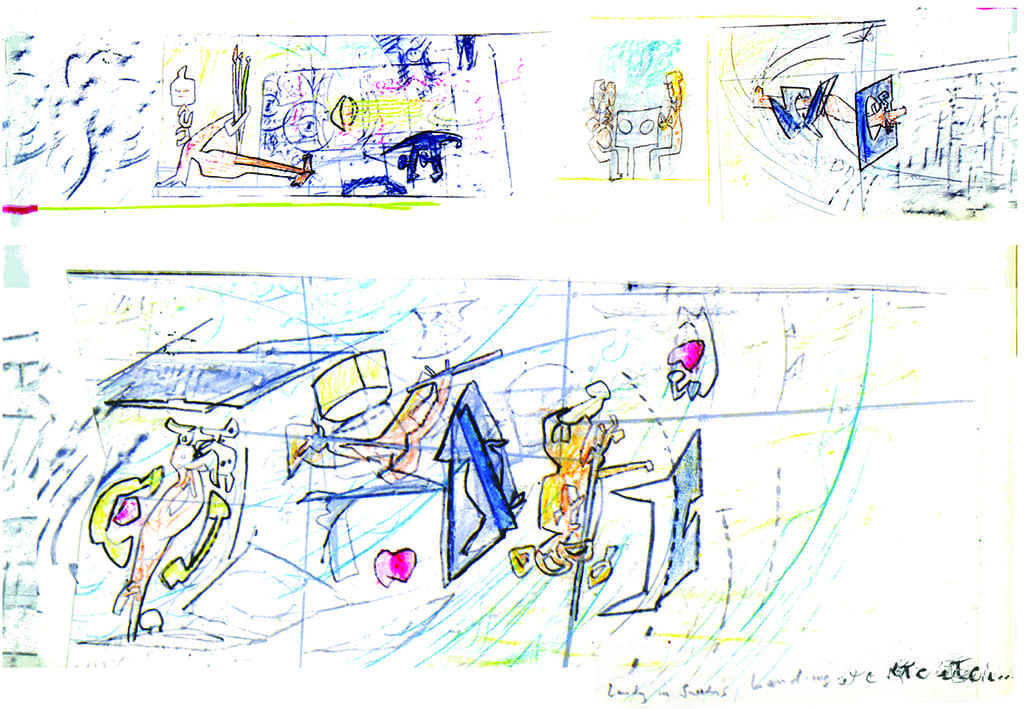
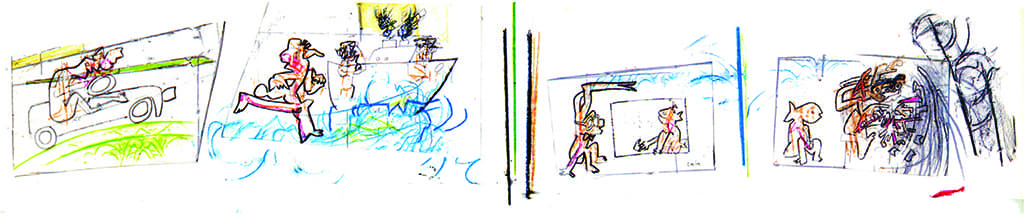
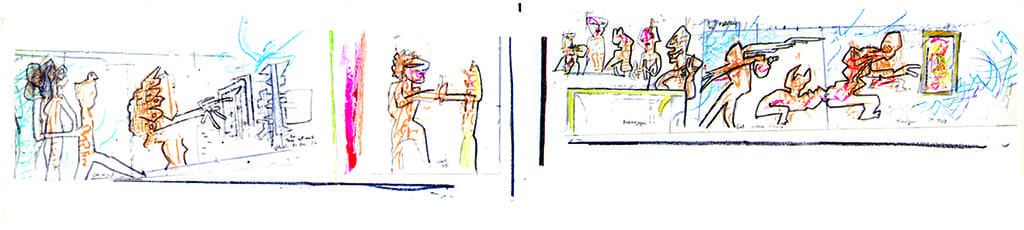
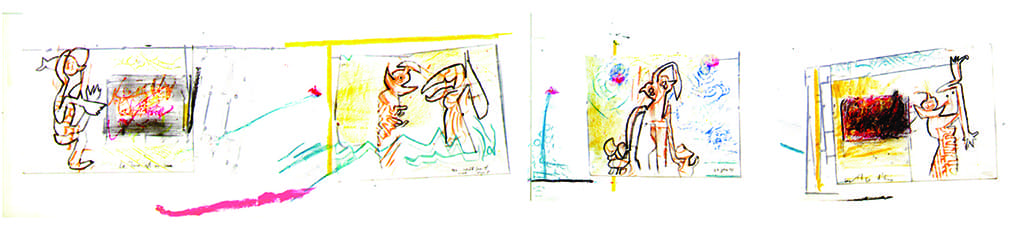
Birth of twins Gordon and Batan XBac and Nubac for whom he draws on a 13-meter-long scroll: Les Aventures d'un couple de biomorphes. He then participated in two major group exhibitions, War and the Artist, held at the Pierre Matisse Gallery, and Spring Talon for Young Artists, at Peggy Guggenheim's Art of this Century gallery.
From the autoelastobiography:
June 23, 1943 Birth of twins Gordon and Batan (Xibel and Nubac)
August 1943 “Herpes Zoster”
NOVEMBER 1943/JANUARY 1944 The Labyrinth of Desire: Le Vertige d'Eros.

In January exhibits 12 drawings and 15 paintings at the Arts Club of Chicago, and in February-March again 12 canvases at Pierre Matisse's. He illustrates the cover of the fourth and final issue of VVV, and then Arcane 17 by André Breton, with the four symbols of the tarot. He participates in that period in the important group show, Abstract and Surrealist Art in the United States, organized by Sidney Janis, which would later be transferred to Cincinnati and eventually to San Francisco. Matta writes in that year, with Katherine Dreier a short essay on Duchamp, Le Verde Duchamp: la Mariée mise à nu par sei Célibatires, même..., which will be published by the Anonymous Society in conjunction with the Museum of Modern Art. The artist seeks in those months to find “a new image of man”, to “visualize history”. He thus appears for the first time in a painting (later destroyed after criticism from André Breton), a mysterious totem character, Le Vitreur, who will reappear in Science, Conscience et Patience du Vitreur. He moves from inner landscapes to a world open to others.
“Being with this consciousness of the other arises from a personal crisis. (...) the relationship with Ann is deteriorating and the world is in the grip of war” (Marine Nedelec).
On June 21 he married in Los Angeles Patricia O'Connors, whom he had met at the end of the previous year.
From the autoelastobiography:
The Separated Alive. Shaken, I needed to discover a language that was not hypnotic or poetic-oniric, but a language of our time: The Day is an Attack.
I lose myself in Sneedens Landing Le Vitreur - among the glass of the great transparencies. I am in the great transparencies. Every Wednesday I make the father. I draw for the twins a roll 13 meters long: Led adventures d'un biomorphe couple.
SUMMER The signs of Onyx of Electra, La rivolte des contraries and Et At It. Do not invent theories but discover die myths.